Fly Ash Bricks
Definition
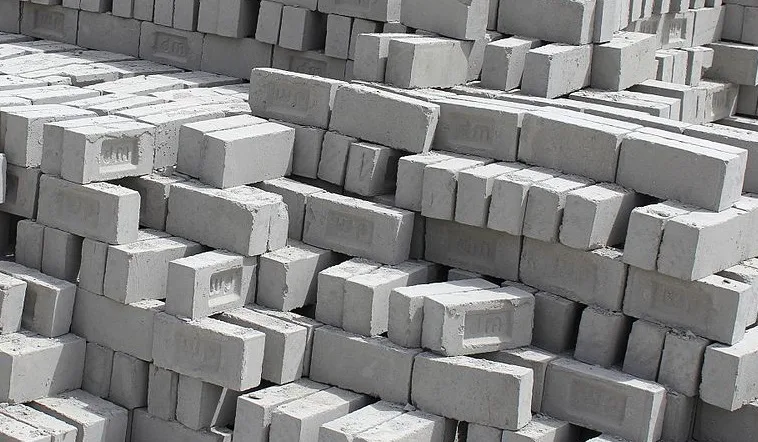
Fly Ash Brick is a masonry unit, made from fly ash, lime or cement, and sand (fine aggregate). These bricks have a pleasing color like cement, are uniform in shape and smooth in finish. The bricks are of dense composition, with/without a frog, free from visible cracks, warp-age, organic matter, pebbles and nodules of free lime.
They are lighter in weight than ordinary clay bricks and less porous too. The color of fly ash bricks can be altered with the addition of admixtures during the process of brick making. They come in various sizes, but generally are similar to the sizes of clay bricks.
Properties
Sound insulation– It provides an acceptable degree of sound insulation.
Thermal properties-These bricks do not absorb heat; they reflect heat and give maximum light reflection without glare. Thermal conductivity is 0.90–1.05 W/m °C (20-30% less than those of concrete blocks).
Fire resistance– Fly ash bricks have a good fire rating. It has no problems with vermin attacks or infestation.
Water absorption is 6-12% as against 20-25% for handmade clay bricks, reducing dampness of the walls.
Structural Capability– These bricks can provide advantages being available in several load-bearing grades, savings in mortar plastering, and giving smart-looking brickwork. High compressive strength eliminates breakages/wastages during transport and handling, the cracking of plaster is reduced due to lower thickness of joints and plaster and basic material of the bricks, which is more compatible with cement mortar. Due to its comparable density, the bricks do not cause any extra load for the design of structures and provide better resistance for earthquake loads due to panel action with high strength bricks.
Compressive strength of fly ash sand lime bricks is av. 9.00 N/mm² (as against 3.50 N/mm² for handmade clay bricks)
Durability- These blocks are highly durable, after proper pointing of joints, the bricks can be directly painted in dry distemper and cement paints, without the backing coating of plaster. Rectangular faced with sharp corners, solid, compact and uniform.
Buildability-The blocks have easy workability and high compressive strength eliminates breakages/wastage during handling giving a neat finish, with a lower thickness of joints and plaster. The construction technique remains the same as regular bricks ensuring easy change of material, without requiring additional training for the masons.
Availability– Though these bricks are abundantly available closer to thermal power plants all over the country for obvious reasons, finding dealers in all major cities and towns wouldn’t be a problem.
The cost of the fly ash bricks is similar to the clay bricks or can be lower in urban areas where fly ash material is easily available.
Application
The blocks being available in several load-bearing grades are suitable for use:
- Load bearing external walls, in low and medium-size structures.
- Non-load bearing internal walls in low and medium-size structures.
- Non-load bearing internal or external walls in high-rise buildings.
MANUFACTURING PROCESS
Materials required:
- Fly ash
- Lime
- Gypsum
- Sand.
Process involved:
- Mixing the ingredients
- Pressing the mix in the machine
- Curing the brick for a stipulated period
Detailed description of the manufacturing process:
The process of manufacturing of fly ash bricks is based on the reaction of lime with silica of fly ash to form calcium silicate hydrate (C-S-H) which binds the ingredients to form a brick. The quality of bricks obtained is highly dependent on the quality of fly ash. The manufacturing of LIME-FLY ASH bricks is generally designed such that they stand at par with burnt clay bricks used conventionally.
FLYASH: (usage 60-70 %) Apart from conforming to IS requirement the minimum requirements for manufacturing of fly ash bricks are as follows:
- Loss on ignition – should not be more than 12%
- Availability of MgO – should not be more than 5%
- Availability of SiO2 – should not be less than 35%
- Availability of Al2O3 – should not be more than 15%
LIME: (usage 8-15%) Lime is a very important ingredient used for the manufacturing of bricks, hence it should satisfy the following minimum requirements: during slaking, the lime should attain a temperature of not less than 60 °C and the slaking time should not be more than 15 minutes. The availability of CaO should be a minimum of 60%. MgO content should be a maximum of 5%.
GYPSUM: (usage 2–5%) It is added to mix in order to accelerate the hardening process and acquire early strength. It should have a minimum of 35% of purity.
SAND: (usage 0- 8%) Addition of sand is optional, but to enhance the gradation, of the mix, addition of coarse sand is quite preferable. The addition of sand also enhances the resistivity of mix to the formation of laminar cracks caused due to entrapped air.
MIXING PROCESS
After all the materials are taken in the required proportion as mentioned above, the first step involved is the mixing of the ingredients.
PRESSING THE MIX IN THE MACHINE
After the mixing process is over, the next step is pressing the mix in the machine to get a good shape and good strength of the bricks.
Curing of Bricks– After the mixing and pressing process is over curing is very important; if the bricks are not cured properly, the proper strength is not gained and, as a result, the final bricks cannot be used for any type of work. Proper curing of bricks is very important for the bricks to gain their strength. It should be cured for a period of two weeks. Since it is prepared from waste material, it gains a cementitious property after proper curing is done. After the curing process is over the brick is now ready for the use.
Advantages and Disadvantages
ADVANTAGES:
- It is durable.
- It has a low water absorption tendency.
- It also consumes low mortar.
- It is economical and ecofriendly.
- Low energy consumption.
- No emission of greenhouse gases.
DISADVANTAGES:
- Needs skilled labour.
- Needs a lot of care while manufacturing.
- The initial cost is more.