
Cement has many different physical properties. Physical properties help to find quality of cement. If cement lies within specified limits of its physical properties then it indicates quality of the cement is good.
Fineness Of Cement
The size of the particle of the cement is known as Fineness of the cement. Finer the cement, faster the chemical reaction with water. In other language Heat of hydration of the cement is directly proportional to the fineness of the cement. This is why very fine or very large particle of the cement is not desirable. Sieve analysis method can be used to find fineness of the cement.
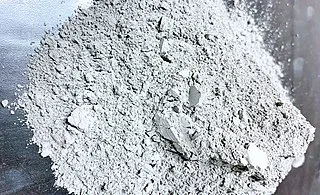

Soundness
- Soundness of cement can be defined as its ability to retain its volume after hardening. If cement changes its volume at the time of setting or hardening then it’s not sound. This means sound cement doesn’t go or undergoes minimum volume change after hardening. Lime content in cement plays a significant role in soundness.
- Cement contains composition of lime, silica, magnesia, sulfur trioxide, iron oxide, calcium sulphate etc. Out of this lime has maximum content (60-67%). If lime content is less, then cement will set fast and if it’s more, then cement will become unsound.
- Unsoundness or volume change in cement or concrete may lead to crack formation in members. Cracks weaken the structure. So cement must be sound enough to resist volume change.
- Therefore finding out the soundness of cement is very important to avoid cracks or to maintain structure strength.

Consistency
- It is a minimum quantity of water requirement to start chemical reaction with cement to form a paste. Hence consistency test helps to calculate minimum requirement of water to make cement paste.
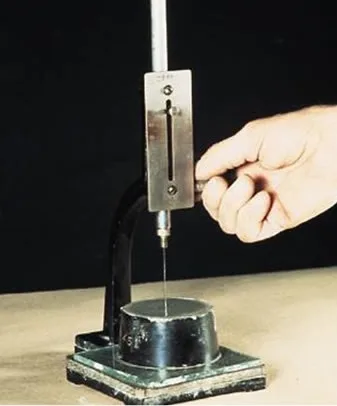
- Standard Consistency: Requirement of water for making cement paste can be found out by the plunger of the Vicat apparatus penetrating the cement paste about 5mm to 7mm from the bottom of Vicat mould.
Strength
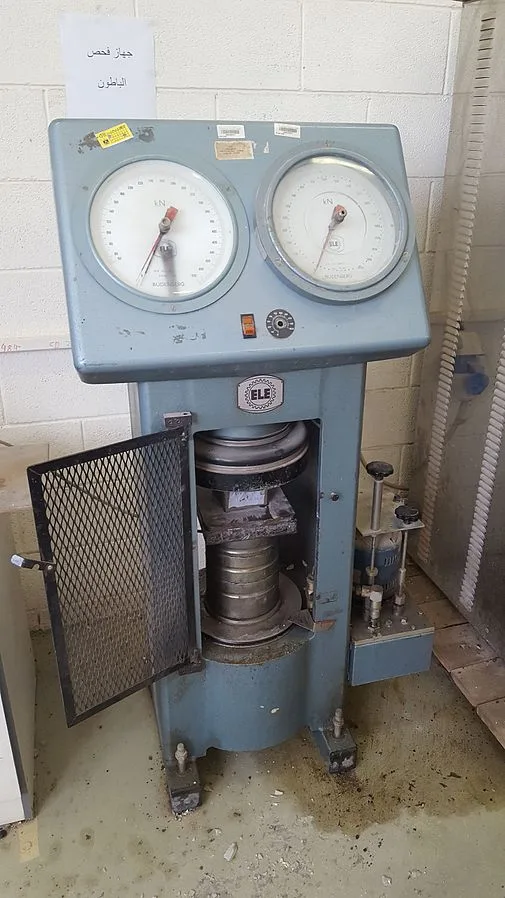
- Cement has both Tensile and Compressive strengths. Cement is planned for High compressive strength. But it has low Tensile strength.
- Compressive strength of cement is the ability of the cement to withstand the compressive load. It helps to find out how much compressive load cement can take before failure. This is the most important property as cement is expected to withstand the desired compressive load.
- Tensile strength of cement is the ability of cement to resist tensile force applied on it. Cement is good performer in terms of compression, but significantly weak in tension force. This is the reason reinforcement is provided to balance weakness of concrete in tensile strength.
Setting Time
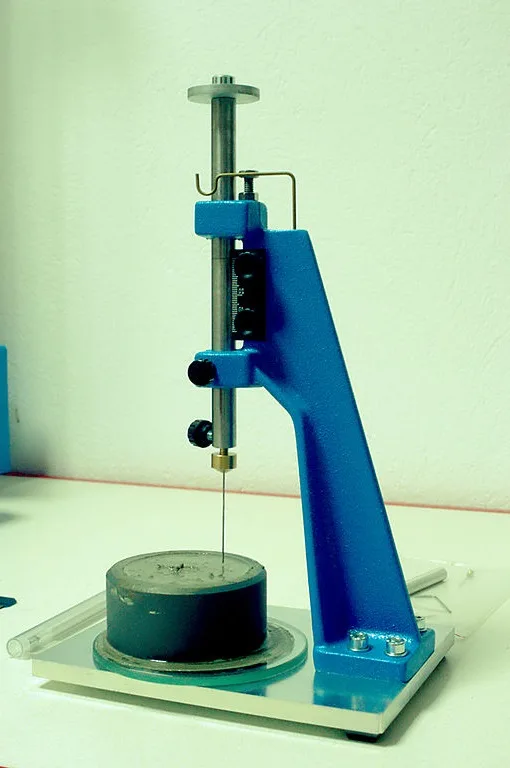
- When Water is mixed in cement it starts a chemical reaction. Then hydration process starts and makes a cement paste. This paste can be moulded in any shape until it hardens. Cement continues to react with water and slowly starts losing its plasticity and ultimately hardens. Time taken to harden the cement after mixing water into it is called as setting time of cement.
- Initial Setting Time: Time taken between Water mixed with cement to the time when Cement paste starts losing its plasticity. For ordinary portland cement, this time should not be less than 30 minutes.
- Final Setting Time: Time taken between Water mixed with cement to the time when Cement paste has completely lost its plasticity. For ordinary portland cement, this time should not be more than 600 minutes or 10 hours.
Heat of Hydration
- When Portland cement is mixed with water, heat is liberated. This heat is called the heat of hydration, the result of the exothermic chemical reaction between cement and water.
- The heat generated by the cement’s hydration raises the temperature of concrete. These temperature rises cause expansion while the concrete is hardening. If the temperature rise is significantly high and the concrete undergoes nonuniform or rapid cooling, stresses due to thermal contraction in conjunction with structural restraint can result in cracking before or after the concrete eventually cools to the surrounding temperature. This is why hydration process of cement is important to know.
- Cements with higher contents of tricalcium silicate and tricalcium aluminate, as well as a higher fineness, have higher rates of heat generation than other cements.
- Tricalcium silicate and tricalcium aluminate chemically generate more heat.
- Higher fineness provides a greater surface area to be wetted, resulting in an acceleration of the reaction between cement and water. This causes an increase in the rate of heat liberation at early ages.
- Other factors influencing heat development in concrete include the cement content, water-cement ratio, placing and curing temperature, the presence of mineral and chemical admixtures, and the dimensions of the structural element.
Loss on Ignition
In the cement industry, use of the term Loss on Ignition (LOI) normally refers to a mass loss in a sample heated to up to a maximum of 1,000 °C. The cement industry utilizes the LOI method to determine the water content and/or carbonation in the cement as these reduce the quality. A high loss on ignition can indicate pre-hydration and/or carbonation, which may be caused by improper and prolonged storage or adulteration during transport or transfer by suppliers. Testing cement using the LOI method can be used as an indicator which can be employed to monitor and improve the quality of the final product.
Specific Gravity
Specific gravity is generally used in mixture proportioning calculations. Portland cement has a specific gravity of 3.15, but other types of cement (for example, portland-blast-furnace-slag and portland-pozzolan cement) may have specific gravities of about 2.90.