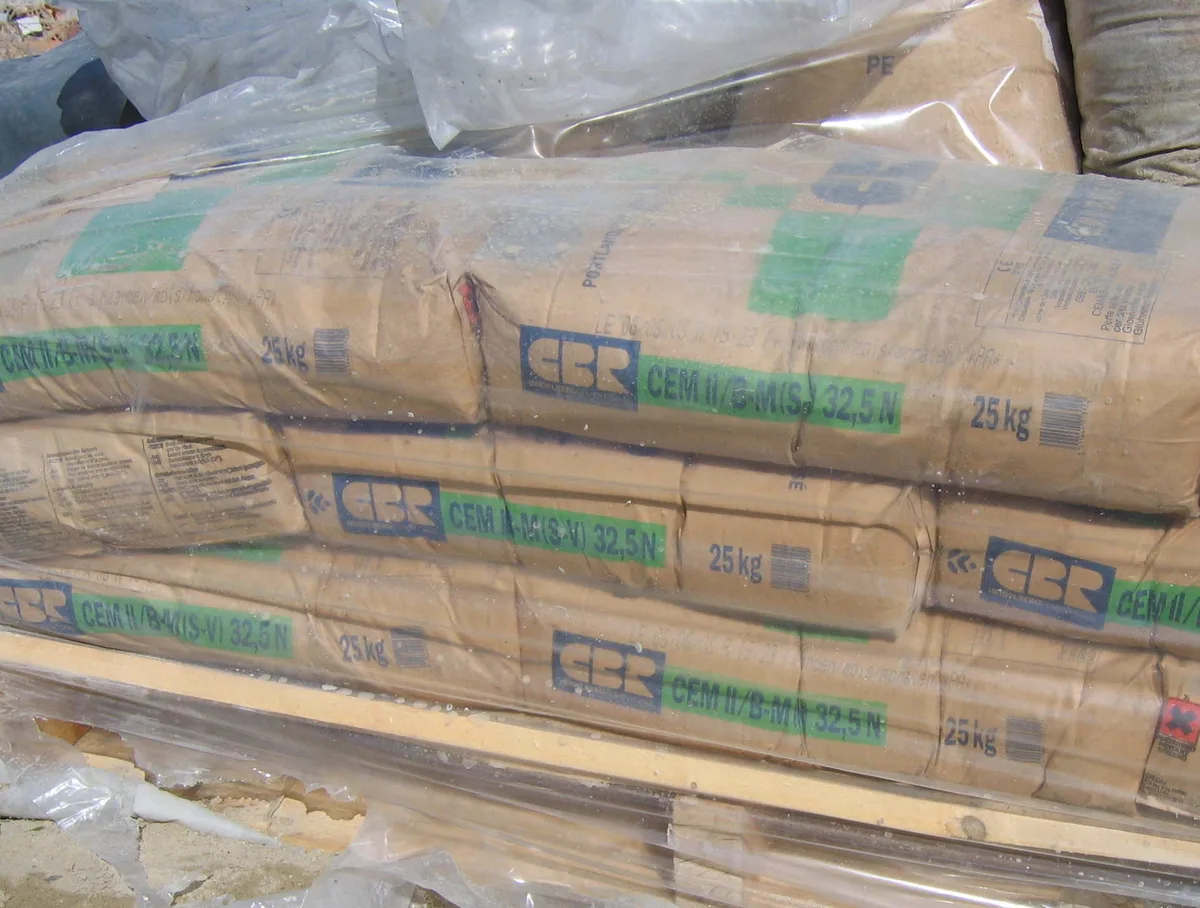
Manufacturing of cement –
The raw materials required for manufacturing of cement are calcareous material like limestone or chalk and Argillaceous material such as clay or shale.
The various components of Portland cement are lime 63%, silica 22%, alumina 6%, iron oxide 3%, magnesium oxide 2.5%, sulphur trioxide 1.5%, alkalies 0.5 %.
The process of manufacturing of cement consists of grinding of raw materials, mixing them intimately in a certain proportions depending on their purity. After mixing raw materials this composition is burnt in kiln at a temperature of about 1300 to 1500 degree Celsius. At this temperature material sinters and partially fuses to form nodular shaped clinker. The clinker is cooled and ground to a fine powder with addition of about 2 to 3% of gypsum. The product formed by using this procedure is Portland cement.
The clinker consists of four major compounds.
Tricalcium silicate 40%.
Dicalcium silicate 32%.
Tricalcium aluminate 10.5%.
Tetra calcium alumino ferrite 9%.
Tricalcium aluminate and Tetra calcium alumino ferrite compounds are responsible for the initial setting of cement. Whereas the percentage of tricalcium silicate impacts on the strength of cement.
There are two processes of manufacturing of cement. First is wet process in which the raw material is mixed in presence of water and the other one is dry process in which raw material is mixed without presence of water. The dry process is less costly as compared to wet process because the wet process contains 30 to 35% of water. The percentage of fuel required in wet process is much more than dry process. Dry process of manufacturing of cement is now commonly used in India.
In the wet process the raw material is crushed to smaller fragments.
Types of cement
1. Rapid hardening cement –
It contains high percentage of tricalcium silicate. Due to tricalcium silicate the early strength development is higher. 3 days strength of rhc is equal to 7 days strength of opc. But the ultimate strength will be same as opc.
Rapid hardening cement gives out much greater heat of hydration during early period due to this it should not be used in mass construction.
Use of rapid hardening cement –
In prefabricated concrete construction.
Where form work is required to be removed as early as possible.
In road repair works.
In cold weather concreting.
2. Extra rapid hardening cement –
It is a type of rapid hardening cement in which calcium chloride is added. The percentage of calcium chloride should not exceed two percent by weight of rapid hardening cement. It is necessary that concrete should be used within 20 minutes. It is also necessary that this cement should not be stored for more than a month. The strength of erhc is 25% higher than rhc at 2 days and 10 to 20% higher at 7 days. Ultimately the strength will be same after 90 days.
3. Sulphate resisting cement –
In this type of cement low percentage of tricalcium aluminate and Tetra calcium aluminate ferrite is effective. This cement has high silicate content and percentage of tricalcium aluminate is limited to 5%.
Use of sulphate resisting cement –
a) concrete to be used in Marine condition.
b) to be used in foundation and basement where soil contains sulphate.
c) used for fabrication of pipes which are likely to be used in sulphate bearing soils.
d) in the construction of sewage treatment works.
4. Quick setting cement –
This type of cement sets very early. It is obtained by reducing the gypsum content at the time of clinker grinding. It is mostly used in underwater construction where pumping is involved. It is also used in typical grouting operations.
5. Low heat cement –
As its name it reduces heat of hydration of a concrete in large construction bodies such as dams. Formation of cracks in large bodies is due to heat of hydration of cement this cement produces less heat at a low rate during the hydration process. Achieved by reducing the contents of tricalcium silicate and tricalcium aluminate.
This cement gives less 7 days strength as compared to ordinary Portland cement. But setting time and soundness are same as that of ordinary Portland cement. This cement is mostly used in large mass concreting.
6. Portland pozzolana cement –
This cement is produced by grinding together Portland cement clinker and pozzolana with addition of gypsum. The pozzolana should not be less than 15% and not more than 35% by weight of Portland pozzolana cement. This cement produces less heat of hydration. Generally it can be used where ordinary Portland cement is usable. The strength of PPC can be same as that of OPC but in later ages provided that concrete should be cured properly for sufficient time period.
7. Coloured cement –
It consists of Portland cement with 5 to 10% of pigment. The pigment is usually ground with cement. For the purpose of long life colour cement it is important that pigment should be durable under exposure to light and chemically composed such as pigment is neither affected by cement nor detrimental to it.
The grey colour of OPC is due to iron oxide present.
With the use of grey cement only red or Brown cement could be produced. For other coloured cements, white cement is used as base. To produce white cement the content of iron oxide is kept low. Raw materials are also used which has lower iron content. Cryolite, that is sodium aluminium fluoride, has at times been added as a flux to aid in burning.
8. Expansive cement –
Generally, cement shrinks while setting due to loss of free water. Concrete also shrinks continuously for a long time. For the purpose like grouting anchor bolts or machine foundations if the cement shrinks the purpose of grouting will have no use.
This type of cement which suffers no overall change in volume on drying is known as expansive cement. This cement is produced by using expanding agent and stabilizer. Generally, about 8 to 20 parts of the sulphoaluminate clinker are mixed with hundred parts of Portland cement with the help of 15 parts of stabilizer. The curing must be carefully controlled.
9. High strength cement –
The cement having much higher strength than ordinary Portland cement is known as high strength cement. It is used for special works such as prestressed concrete precast concrete and air-field works.
The 3 days strength of cement should not be less than 230 kg/cm². For 7 days not less than 330 kg/cm² and for 28 days should not be less than 430 kg/cm². Other properties such as setting time and soundness are same as that of ordinary Portland cement.
Testing of cement –
Field testing
The colour of cement should be normally greenish grey. It should be free from any visible lumps.
Thrust hand into cement bag; it should feel cool.
Cement should give a smooth and not gritty feeling.
The particles of cement should float in water for some time before they sink.
Check the manufacturing date of cement which is written on the cement bag that is in which week and month it is manufactured.