
Soundness of Cement
Soundness of cement can be defined as its ability to retain its volume after hardening. If cement changes its volume at the time of setting or hardening then it’s not sound. This means sound cement doesn’t undergo any volume change, or undergoes only minimum volume change, after hardening. Lime content in cement plays a significant role in soundness.

Significance
- Cement contains composition of lime, silica, magnesia, sulfur trioxide, iron oxide, calcium sulphate etc. Out of this lime has maximum content (60-67%). If lime content is less then cement will set fast and if it’s more then cement will become unsound.
- Unsoundness or volume change in cement or concrete may lead to formation of cracks in members. Cracks weaken the structure. So cement must be sound enough to resist volume change.
- Therefore finding out the soundness of cement is very important to avoid cracks or to maintain structure strength.
Apparatus Required
Le-Chatelier Apparatus: Consists of a small split cylinder of brass or other noncorrodible metal of 0.5mm thickness forming a mould of 30mm internal diameter and 30mm high. On either side of the split, two indicators are brazed suitably with pointed ends made of 2mm diameter brass wire in such a way that the distance of these ends to the centre of the cylinder is 165mm. The split cylinder will be kept between two glass plates.
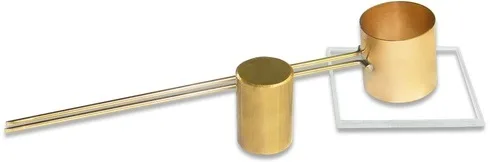
Water Bath: Water bath capable of containing immersed Le-Chatelier moulds with specimens and of raising their temperature from 27±2°C to boiling in 27 ± 3 minutes.
Vernier Caliper: Vernier Caliper should be able to measure up to 30 mm with least count of 0.1 mm
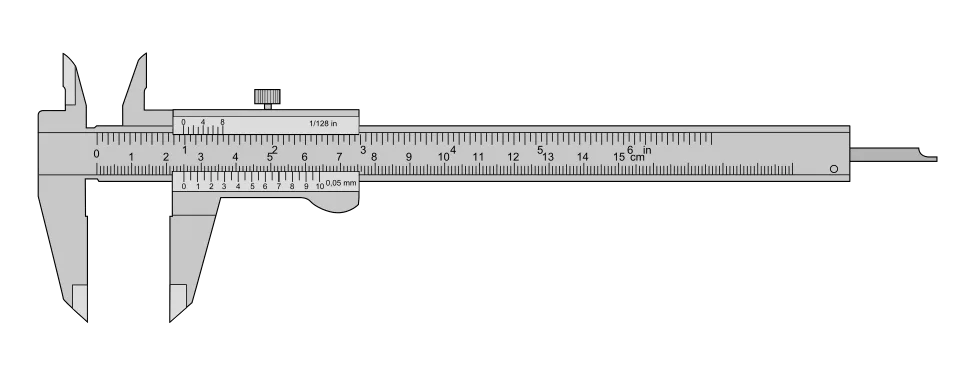
Weight Scale: On balance in use, the permissible variation at a load of 1000 g shall be ± 1.0 g. The permissible variation on new balance shall be one-half of this value. The sensibility reciprocal shall be not greater than twice the permissible variation.

Test Procedure
You must know standard consistency of cement. Add 0.78P (P-Standard Consistency of Cement) of water in Sample cement.
Prepare a paste. Lightly apply oil in Brass cylinder and place Le-Chatelier apparatus on glass plate.
Now pour cement paste in cylinder. Place a Glass plate on top as well.
Then, submerge the whole assembly for 24Hrs in water bath at a temperature of 27 ± 2 °C.
Remove entire apparatus after 24 hours from water. Then measure the distance separating the two indicator points. Note it as L1.
Again submerge the assembly in water and bring the water to boiling temperature.
Remove it after 3 hours of boiling and measure the distance separating the two indicator points. Note it as L2.
Expansion of cement = L2 − L1
L1=Measurement taken after 24 hours of immersion in water at a temp. of 27 ± 2 °C
L2=Measurement taken after 3 hours of immersion in water at boiling temperature. Calculate the mean of two values to the nearest 0.5 mm.
Expansion Limits
| Types of Cement | Expansion Limits |
|---|---|
| Ordinary Portland cement [OPC] 33 Grade, 43 Grade, 53 grade | 10mm |
| Portland Pozzolana Cement [PPC] | 10mm |
| Rapid Hardening cement | 10mm |
| Low heat cement | 10mm |
| Super sulphated cement | 5mm |