
L box Test significance
Slump cone test is useful for workability of concrete. But self compacting concrete is very fluidic. Slump cone test for Self compacting concrete workability doesn’t work. This is why L box test is a good option to check workability of Self compacting concrete. L box test is used to find workability of freshly prepared self compacting concrete. It was first used in Japan.

Apparatus
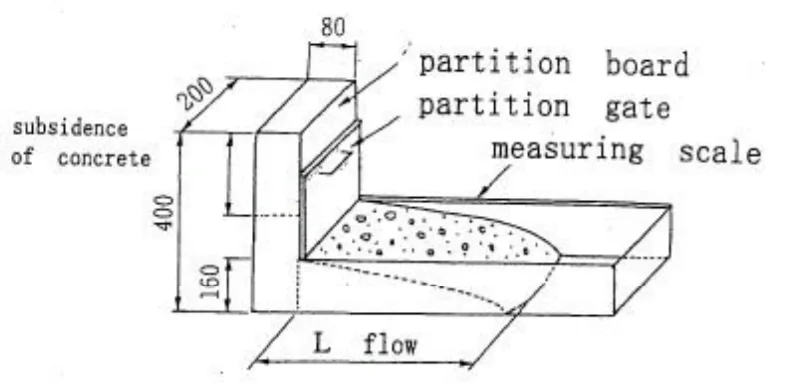
L box Test Apparatus: The tester shall be a device made of steel having the shapes and dimensions shown below.
Stopwatch: To measure time

Procedure
- Place the L-type flow tester on a horizontal plane and wipe the internal surfaces of the tester with a wet cloth.
- Attach the sliding gate to the L-type flow tester and pour the sample using the charging container in one layer without applying rodding or vibration.
- Level the top surface of the concrete filled in the tester with the top edge using a straightedge.
- When the top surface has been leveled, immediately raise the sliding gate. An L-flow refers to the distance between the inside of the sliding gate and the tip of concrete.
- Measure the time to reach an arbitrary L-flow with a stopwatch.
- The L-flow when the motion of concrete stops is referred to as the maximum L-flow. Also, measure the subsidence of concrete from the initial level by reading the length from the top edge of the tester to the highest point of the concrete with a measuring scale.
- Select a point along the channel to which the flow time can be measured with a stopwatch, judging from the target L-flow. Measure the time from the moment the sliding gate is raised to the moment the tip of concrete reaches the point. The standard distance to measure the L-flow time is 500 mm.
Note: In L-type flow tests, concrete near the side walls of the channel can exhibit a slightly lower flow speed than concrete in the center, due to friction with the side walls.
Calculations
The flow speed of concrete shall be calculated by the following equation and rounded off to an integer:
Vi = Li / tiwhere Vi = average flow speed of concrete to an L-flow of i mm (mm/s); Li = L-flow distance to which the L-flow time is measured (mm); ti = time to reach an L-flow distance of i mm (s)