
Components and significance
Flexural strength of the concrete is a measure of its tensile strength: the ability of an unreinforced concrete beam or slab to resist failure in bending. The result of the flexural test on concrete is expressed as a modulus of rupture, in MPa (N/mm²) or psi. Concrete is good in compression and weak in tension, but at the time of designing a pavement or slab, the tensile strength of the concrete is also taken into consideration. That is why knowing tensile strength is important.

Aim
To determine flexural strength of the hard concrete. Specimen size is 150mm x 150mm x 700mm.
Apparatus
Beam Mould: Size 150mm x 150mm x 700mm or 100mm x 100mm x 500mm
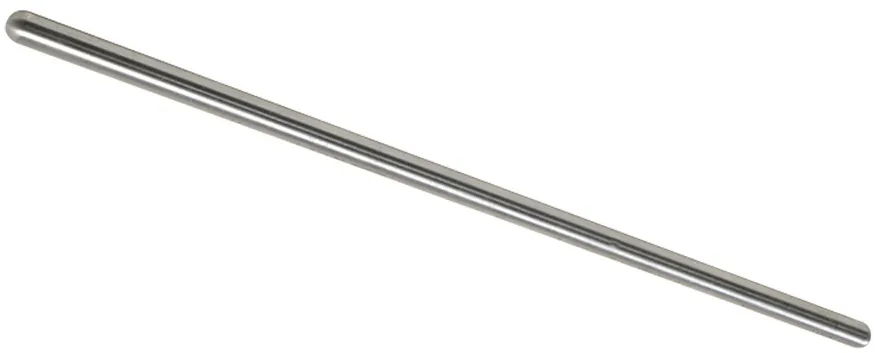
Tamping Bar: For material compaction at the time of casting
Flexural Test Machine: to provide flexural load
Procedure
- Prepare the test specimen by filling the concrete into the mould in 3 layers. Tamp each layer 25 times using the tamping bar as specified above.
- Clean the bearing surfaces of the supporting and loading rollers, and remove any loose sand or other material from the surfaces of the specimen where they are to make contact with the rollers.
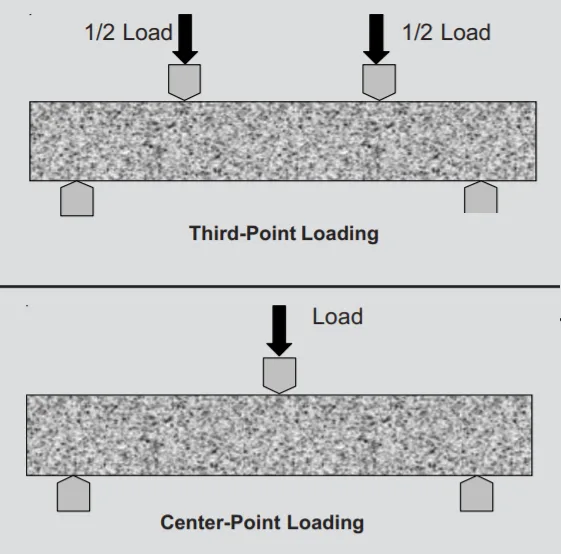
- Circular rollers manufactured out of steel having cross section with diameter 38 mm will be used for providing support and loading points to the specimens. The length of the rollers shall be at least 10 mm more than the width of the test specimen. A total of four rollers shall be used, three out of which shall be capable of rotating along their own axes. The distance between the outer rollers (i.e. span) shall be 3d and the distance between the inner rollers shall be d. The inner rollers shall be equally spaced between the outer rollers, such that the entire system is symmetrical.
- Specimens stored in water shall be tested immediately on removal from water, whilst they are still wet. The test specimen shall be placed in the machine correctly centered with the longitudinal axis of the specimen at right angles to the rollers. For moulded specimens, the mould filling direction shall be normal to the direction of loading.
- The load shall be applied at a rate of loading of 400 kg/min for the 15.0 cm specimens and at a rate of 180 kg/min for the 10.0 cm specimens.
Result and Calculations
fb = pl/bd2(when a > 20.0cm for 15.0cm specimen or > 13.3 cm for 10.0 cm specimen)
or
fb = 3pa/bd2(when a < 20.0cm but > 17.0 cm for 15.0cm specimen or < 13.3 cm but > 11.0cm for 10.0cm specimen.)
Where,
fb = Modulus of rupture or flexural strength
a = the distance between the line of fracture and the nearer support, measured on the center line of the tensile side of the specimen
b = width of specimen (cm)
d = depth of specimen at the point of failure (cm)
l = supported length (cm)
p = max. Load (kg)